
Introduction
In 2017, facing a structural decline in mail volumes, La Poste was exploring new use cases for its delivery workforce and looking to leverage its unique territorial network. Midi-Pile is a service concept I designed during my work-study placement at Groupe La Poste: a lunch delivery service targeting employees of startups and SMEs, companies too small to have a corporate cafeteria but whose teams want to eat well, quickly, and without overspending. The concept brings together a consumer-facing mobile app, a dedicated interface for partner caterers, and a modular packaging system, all designed to fit naturally into existing postal delivery routes. The project was conceived, designed, and pitched to La Poste's IT division in collaboration with Thomas Nicolas, a graphic designer.
How might we design a viable and desirable lunch delivery service built on La Poste's existing infrastructure and territorial network, in order to offer a quality alternative to employees of small companies while creating a new revenue stream for the Group?
End-to-end stakeholder and journey mapping, value proposition and delivery scenarios tied to existing postal rounds, framing the full system (app, caterers, packaging) for the internal IT pitch.
Employee flows for ordering and reimbursement, operational flows for caterers, wireframes and high-fidelity UI for the mobile app and back-office screens, aligned with the visual identity led by my design partner.
Benchmark of food-delivery players and meal-voucher schemes, synthesis of workplace lunch studies, surfacing expectations (price, time window, receipts) and adoption barriers for the concept.
Problem definition
In 2017, the food delivery market was growing fast, driven by players like Deliveroo and UberEats, but their model was primarily aimed at individual consumers and evening use cases. The corporate lunch segment was still dominated by meal vouchers, a system designed for large organizations, and by whatever fast food happened to be nearby. SMEs and startups, often located in less central areas, were largely left out of the equation. La Poste, with its nationwide presence and morning delivery rounds, held a structural logistics advantage that no other player could easily replicate.
As a prospective concept project, the research phase relied on a competitive benchmark and an analysis of existing studies on the eating habits of working adults, expectations around workplace lunches, and barriers to adopting delivery services. Three core expectations emerged: a price-to-quality ratio that feels fair, maximum convenience (order fast, receive at a fixed time), and expense traceability to make employer reimbursement straightforward.
Build on La Poste's existing infrastructure
The group's sorting and distribution hubs and its morning delivery rounds form a logistics network that is already funded and operational. Midi-Pile didn't need to build a supply chain from scratch, only to activate it on a new time slot.
Address a real and underserved need
Employees of small companies have neither a corporate cafeteria nor a delivery service designed with them in mind. A reliable service, delivered before 1pm, featuring locally sourced caterers, could fill a gap that existing players had left wide open.
Design a system where every stakeholder wins
The service only holds together if everyone in the chain gets value from it: employees eat better and more easily, caterers gain a new distribution channel without added logistics overhead, postal workers make better use of their rounds, and La Poste diversifies its revenue.
Solution design
The project covered the full service system: from the end-user experience through to the operational interface for caterers, including packaging and visual identity. The division of work with Thomas Nicolas followed our respective areas of expertise naturally. I focused on service design, user flows, and the mobile app screens, while Thomas led the art direction, visual identity, and communication materials. On topics like packaging and pitch visuals, we worked jointly.
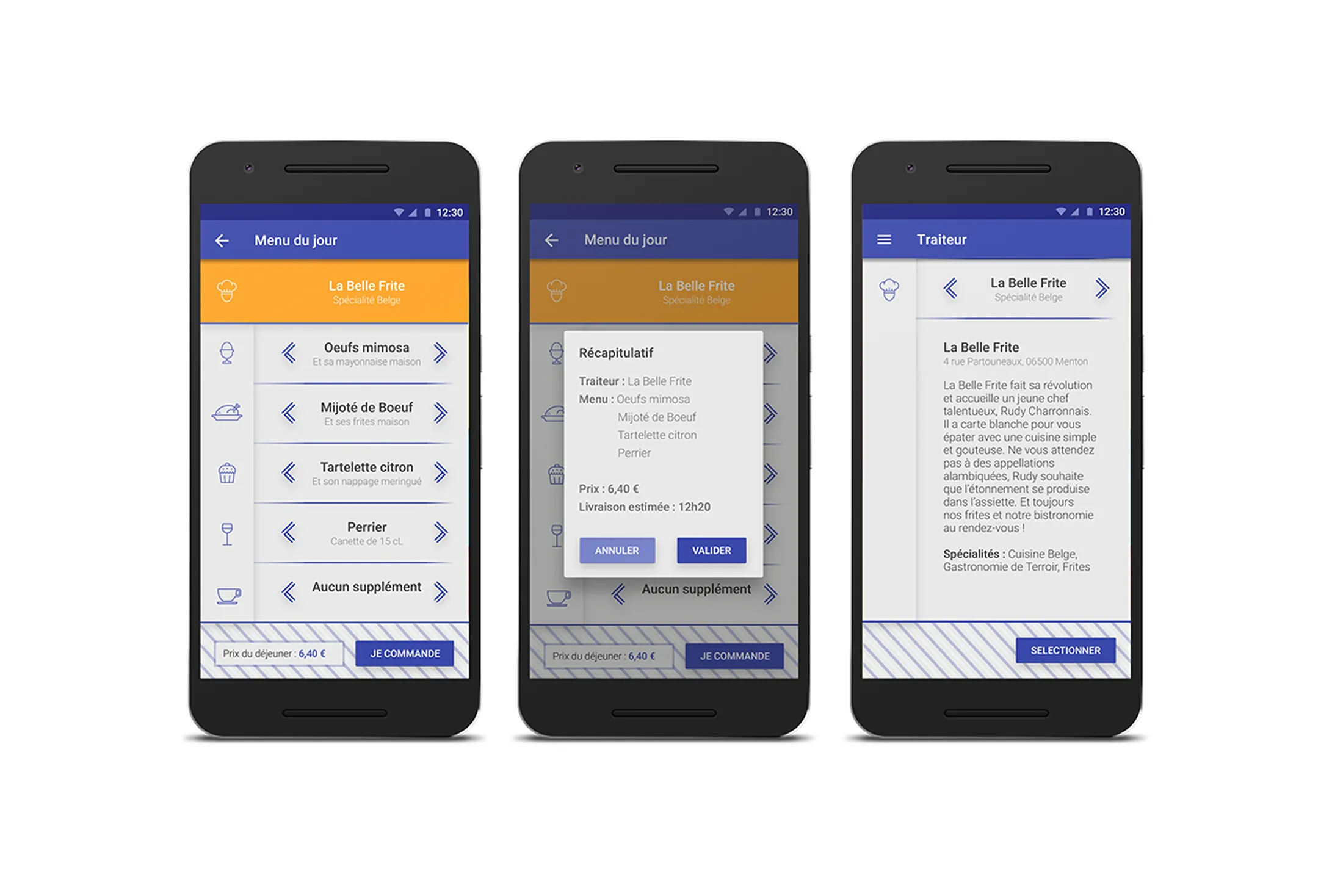
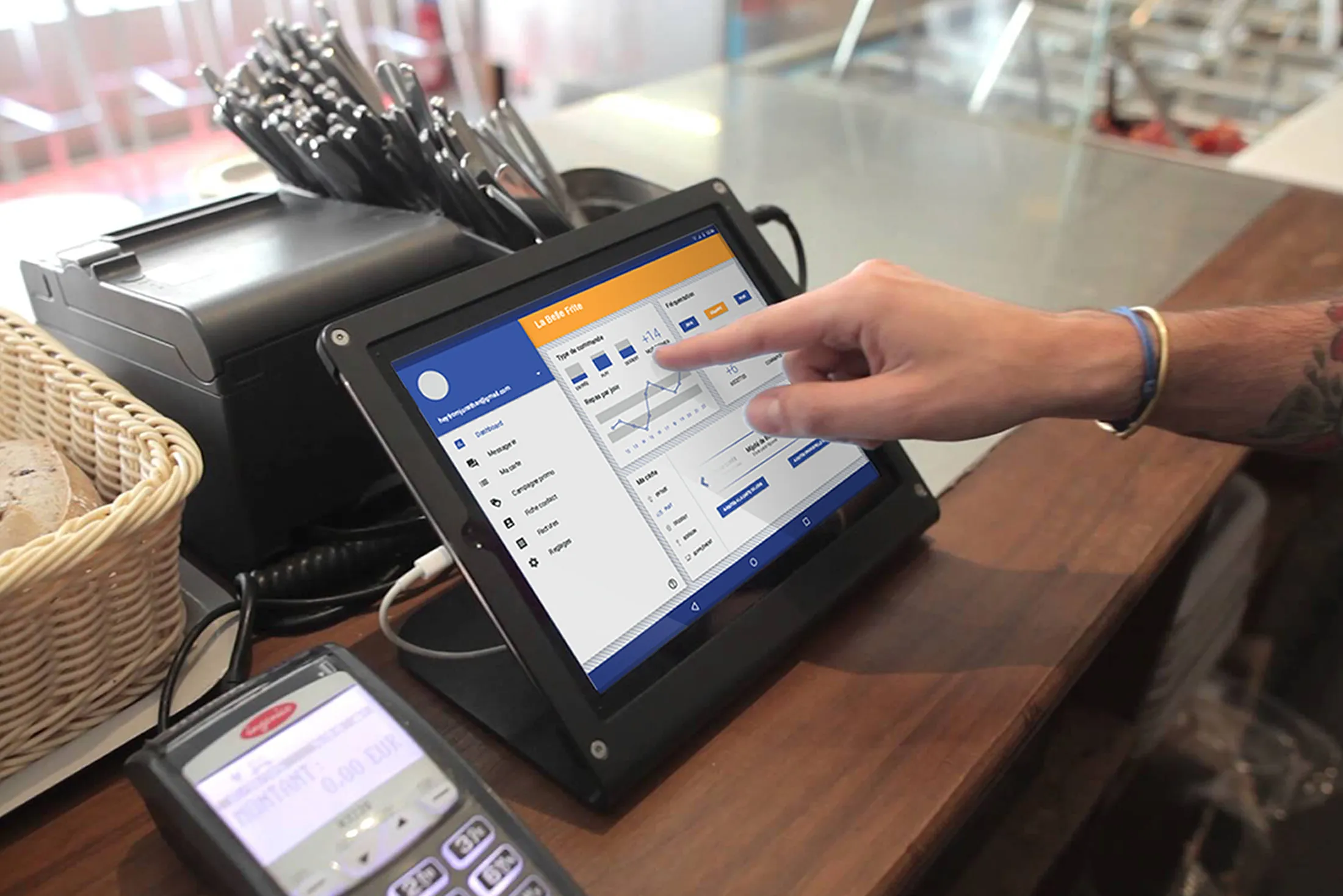
The mobile app was designed around a deliberately short flow: choose a caterer, build your meal, pay, and receive. The ability to retrieve receipts directly within the app addressed a concrete need surfaced during the usage analysis, that of expense justification for employer reimbursement. It may seem like a minor detail, but in the day-to-day of a startup employee, it is exactly the kind of friction that determines whether a service gets adopted or abandoned. The caterer-facing interface was designed with operational efficiency as the guiding principle: daily order management, stock tracking, invoice generation. The challenge was to avoid adding complexity to the routines of professionals who have neither the time nor the inclination to learn a heavy new tool.
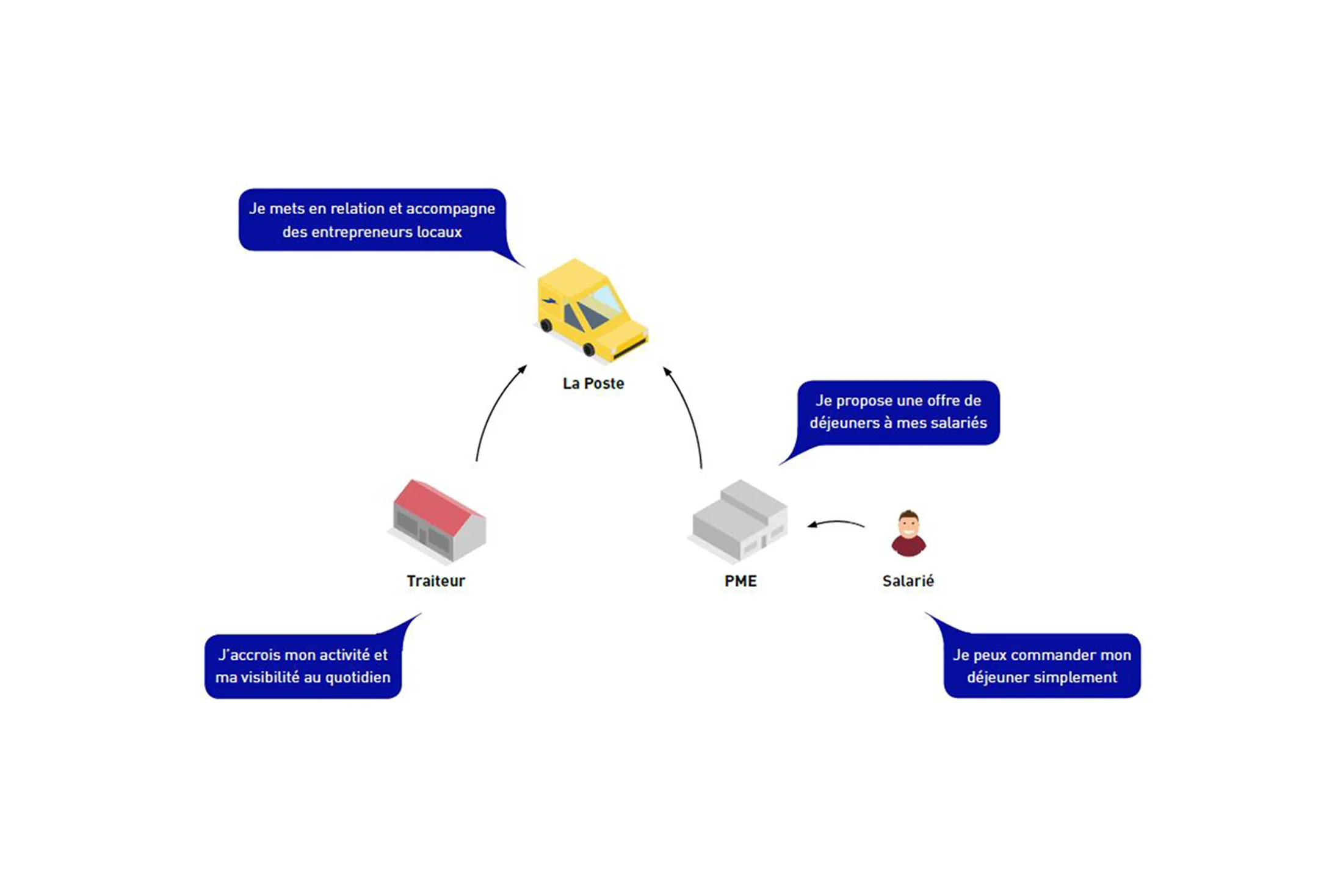
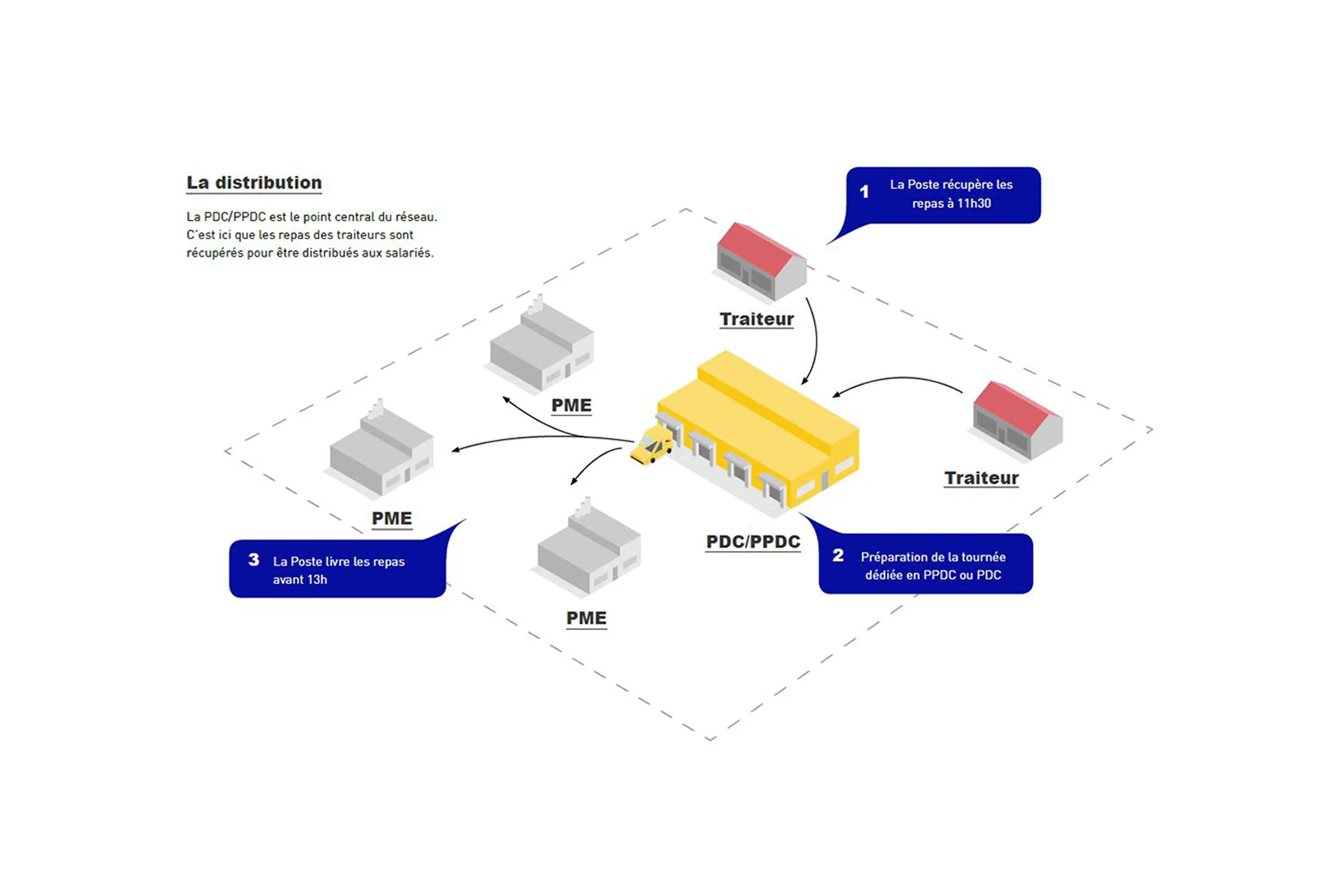
Visual consistency between the mobile app and the physical packaging was a deliberate design decision. The label on each box mirrors the graphic language of the app, creating continuity between the digital experience and the physical object that lands on your desk. The modular stacked packaging system, designed to minimize bulk during transport, was also integrated into the broader design thinking: each level corresponds to a course, starter, main, dessert, with cutlery and a caterer card tucked into the bottom compartment.
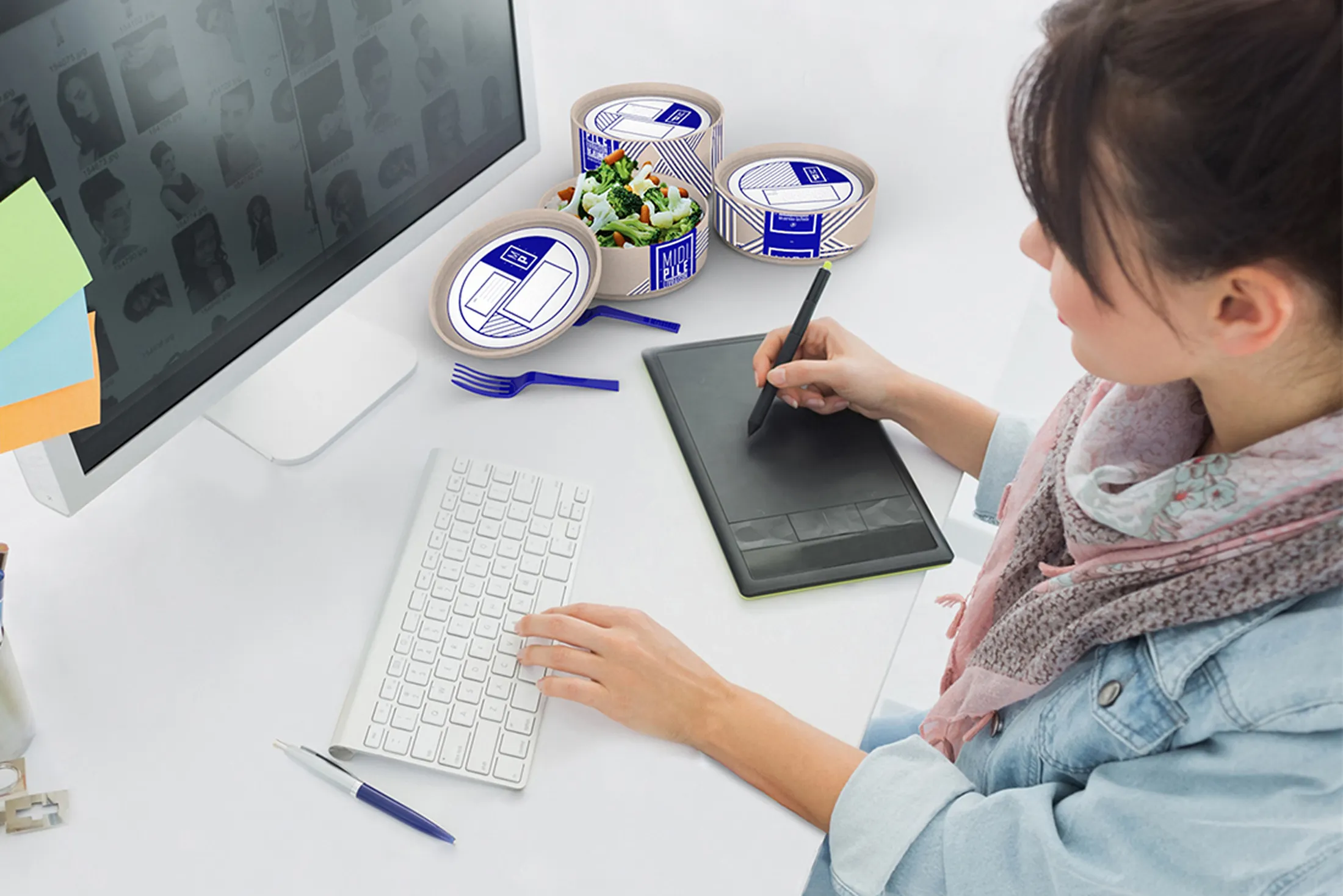
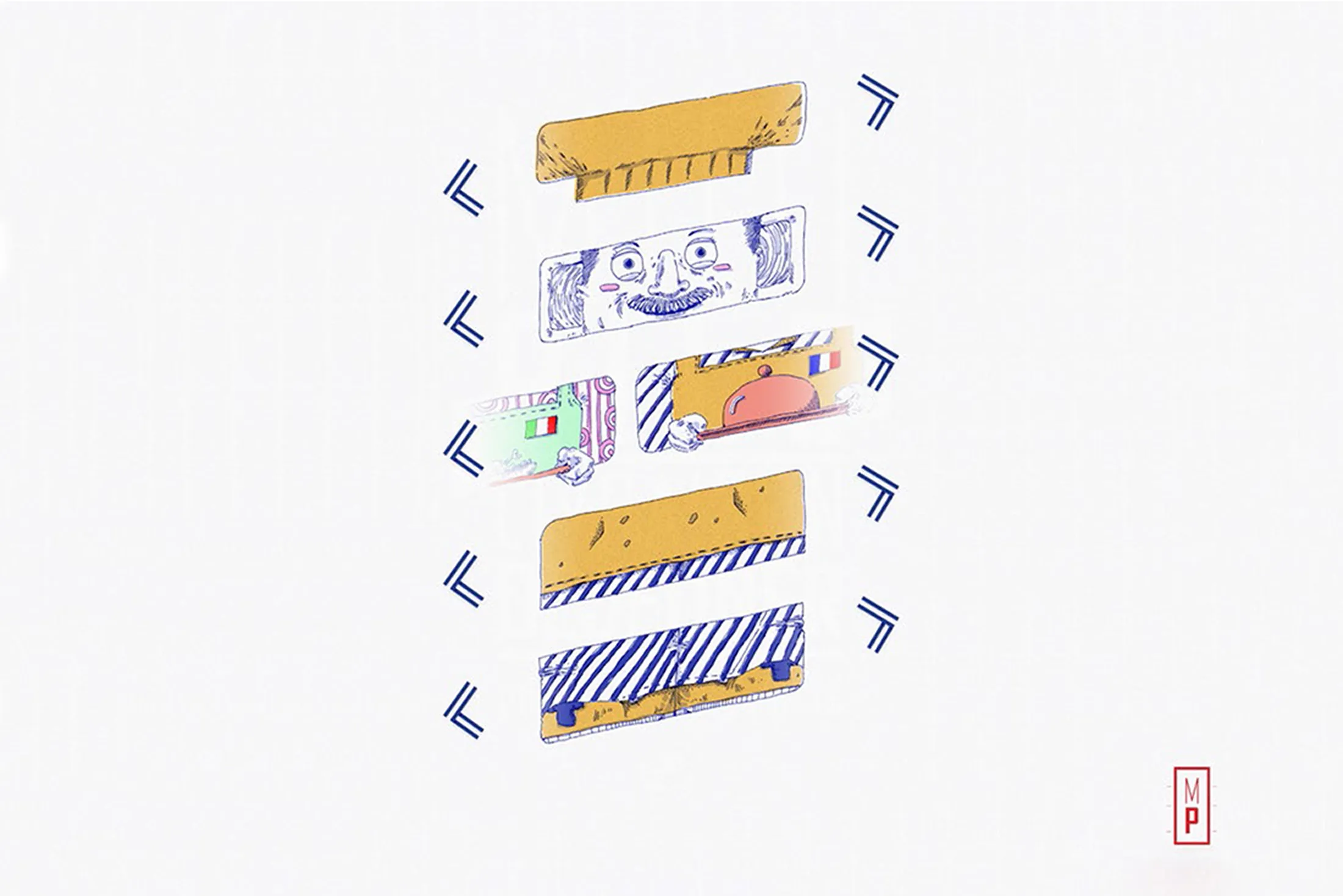
Midi-Pile being a prospective concept intended for an internal pitch, there was no development phase. The deliverables produced, wireframes, UI mockups, packaging, and communication materials, were designed to present the concept to La Poste's IT division in a compelling and self-contained way.
Results & learnings
The concept was presented to Groupe La Poste's IT division at the end of the placement. The project produced a credible diversification proposal built on existing Group assets, with a complete service vision spanning the user experience, the caterer operational tool, and the brand identity.
This project was one of my first experiences designing in close collaboration with someone whose skills were genuinely complementary to mine, and it taught me something fairly fundamental: working with a strong graphic designer means accepting that you won't control everything, that letting go of certain visual decisions actually frees you to focus on what you do best. When that division of expertise is well negotiated, the result is stronger than what either person could have produced alone.
What would I do differently? I would have pushed to run actual user interviews rather than relying solely on secondary research. Desk research surfaces trends, but it doesn't replace the granularity of a direct conversation with an SME employee who genuinely struggles to find a decent lunch.