
Introduction
Mermoz was born out of personal frustration. In July 2021, I started my ULM pilot training and quickly noticed a striking gap between the technical sophistication of aviation and the outdated tools used day-to-day in flying clubs.
Over the following weeks, through conversations with students, instructors, and club managers, I mapped several unaddressed needs. I decided to focus on the one that felt most actionable: flight scheduling, which remained archaic in the vast majority of clubs and a daily source of errors and wasted time.
In early 2022, I started designing Mermoz on my own, a SaaS platform for aircraft booking and schedule management for flying clubs. Six months later, I presented the project to Lonestone, who agreed to support me through the development phase as part of their Startup Studio.
How might we modernize aeroclub flight scheduling to reduce errors, streamline administrators’ work, and improve pilots’ experience?
Founder & Product Designer (UX/UI design, brand identity, landing page)
Product Management (benchmark, MVP definition, backlog)
Development follow-up (collaboration with the Lonestone team)
Problem definition
I conducted a competitive benchmark to map the existing landscape of flying club management software, analyzing value propositions, features offered to different user profiles (managers, instructors, pilots), business models, and pricing.
The main finding: the market was dominated by a single player in a near-monopoly position, with aging solutions that paid little attention to user experience. This analysis directly informed the definition of the MVP's functional scope, identifying the features needed to be credible at launch while differentiating on experience quality.
I reached out to around 80 flying club managers to present the project and gather their feedback. About ten of them agreed to a phone interview or a live demo, for which I had prepared interview guides and a working demo version of the app.
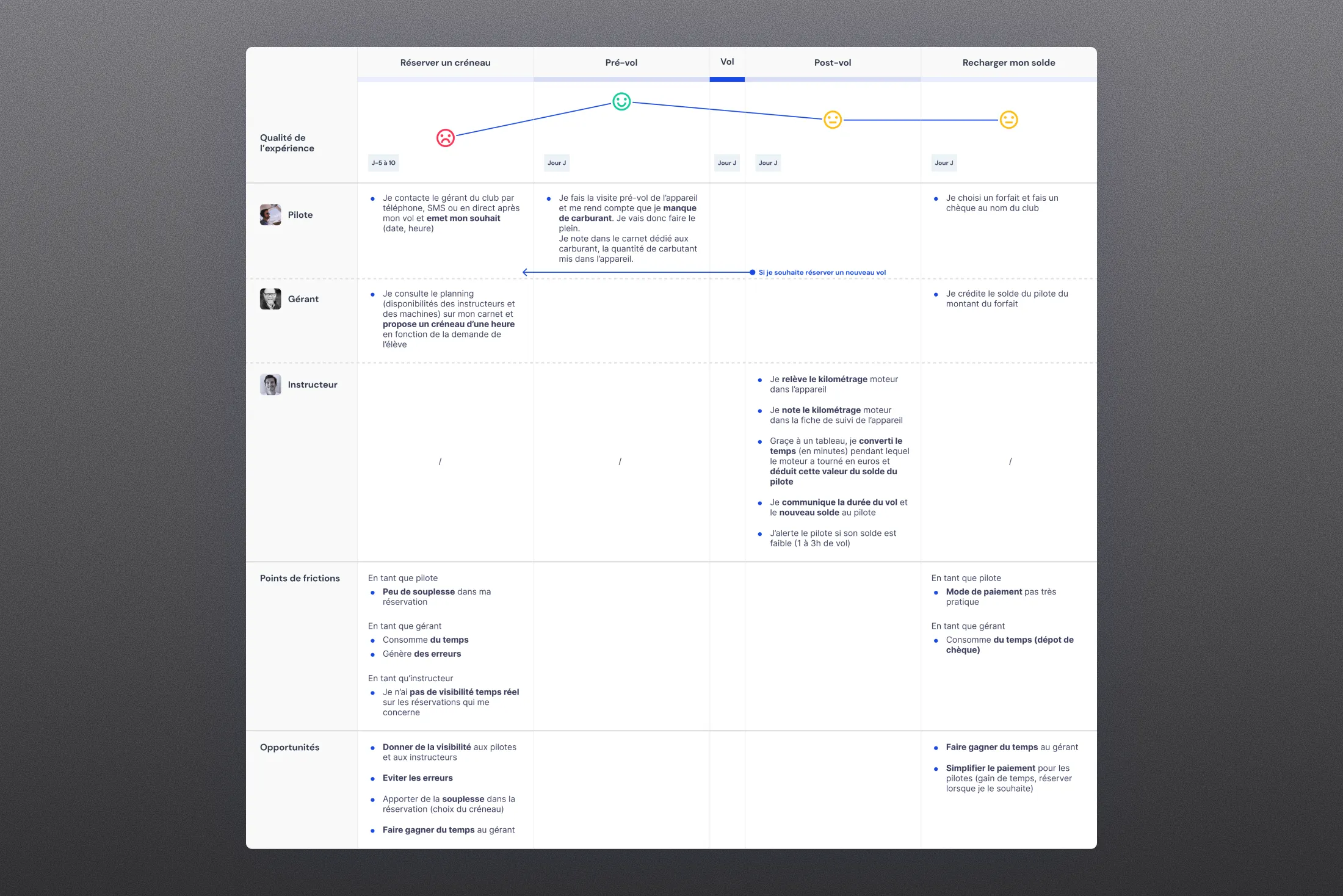
These conversations confirmed the initial hypotheses around pain points, manual scheduling, time-consuming administrative work, and the absence of a smooth booking tool for pilots, and helped sharpen certain functional priorities before development began. Mapping the full booking journey, covering the pilot, the manager, and the instructor, served as the starting point for identifying end-to-end friction and structuring the design work.
A captive and underserved market
Flying clubs need management tools but have very few credible alternatives. A product offering a modern experience at a fair price had every chance of convincing clubs quickly, provided it didn't over-promise on the initial scope.
Put scheduling at the heart of the manager experience
After exploring a more social approach centered on a club activity feed, I chose a more functional and rational direction, focused on schedule management. This more restrained initial ambition was also more realistic to build and more immediately useful for managers.
Pilots as advocates
Beyond managers, pilots could play a prescriptive role within their club. Addressing them directly on the landing page, by showing the value Mermoz would bring to their own experience, was an indirect acquisition lever worth activating early.
Solution design
Before placing a single wireframe, I explored two radically different approaches. The first, social in nature, aimed to treat club life as an activity feed: bookings, member exchanges, news. The idea was appealing on paper but quickly set aside: too costly to develop, difficult to moderate, and poorly suited to a predominantly older audience unlikely to adopt new digital behaviors.
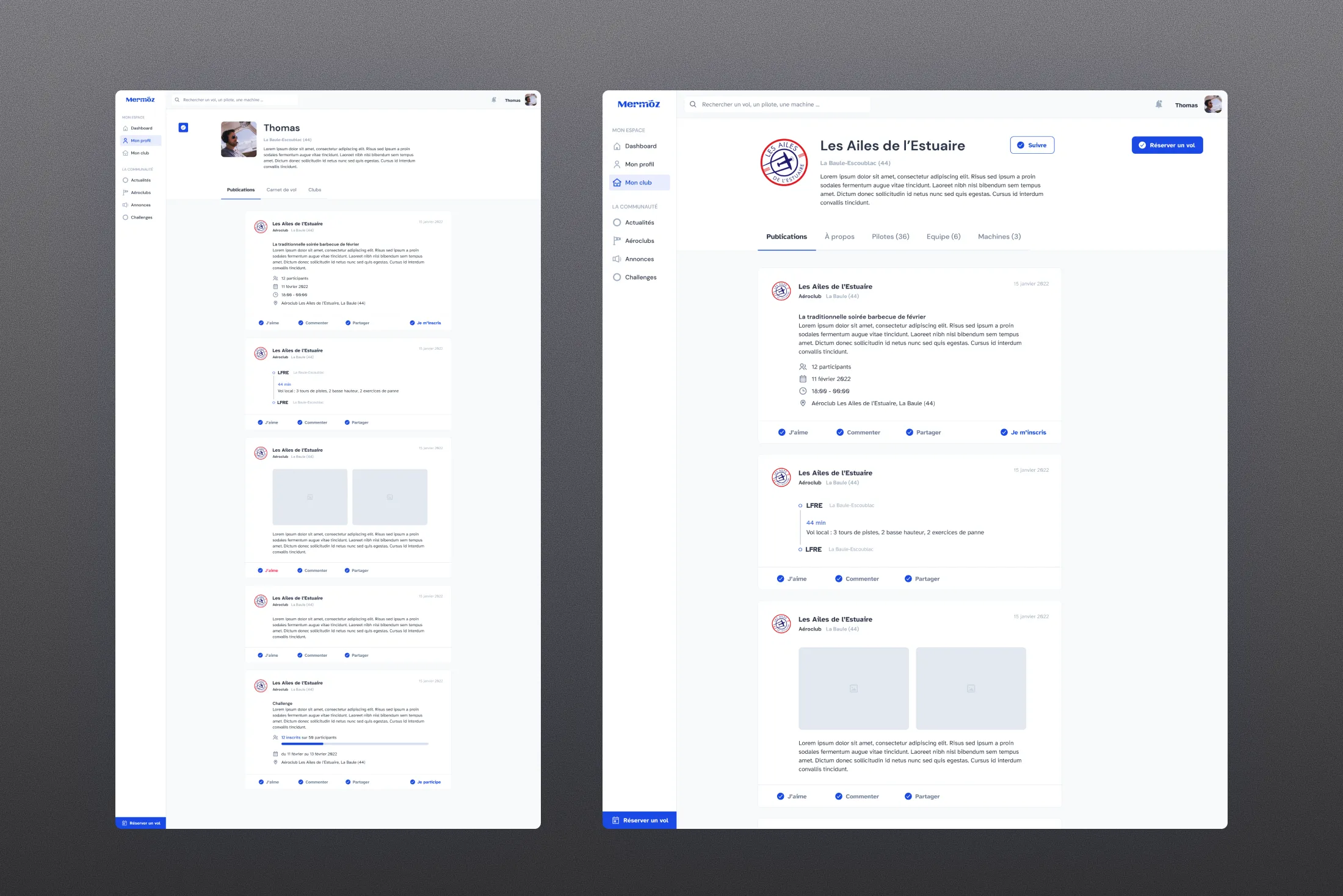
The second approach, more functional and rational, was the one I retained: a SaaS with two distinct access points, one for managers and one for club members, centered on scheduling control and reducing administrative overhead. This choice, more restrained in its initial ambitions, was also more realistic to build and more immediately valuable to managers.
I chose to focus the MVP on two profiles, managers and pilots, deliberately excluding instructors to reduce initial complexity. Features were structured around three key moments in the journey: before the flight, during booking, and after the flight.
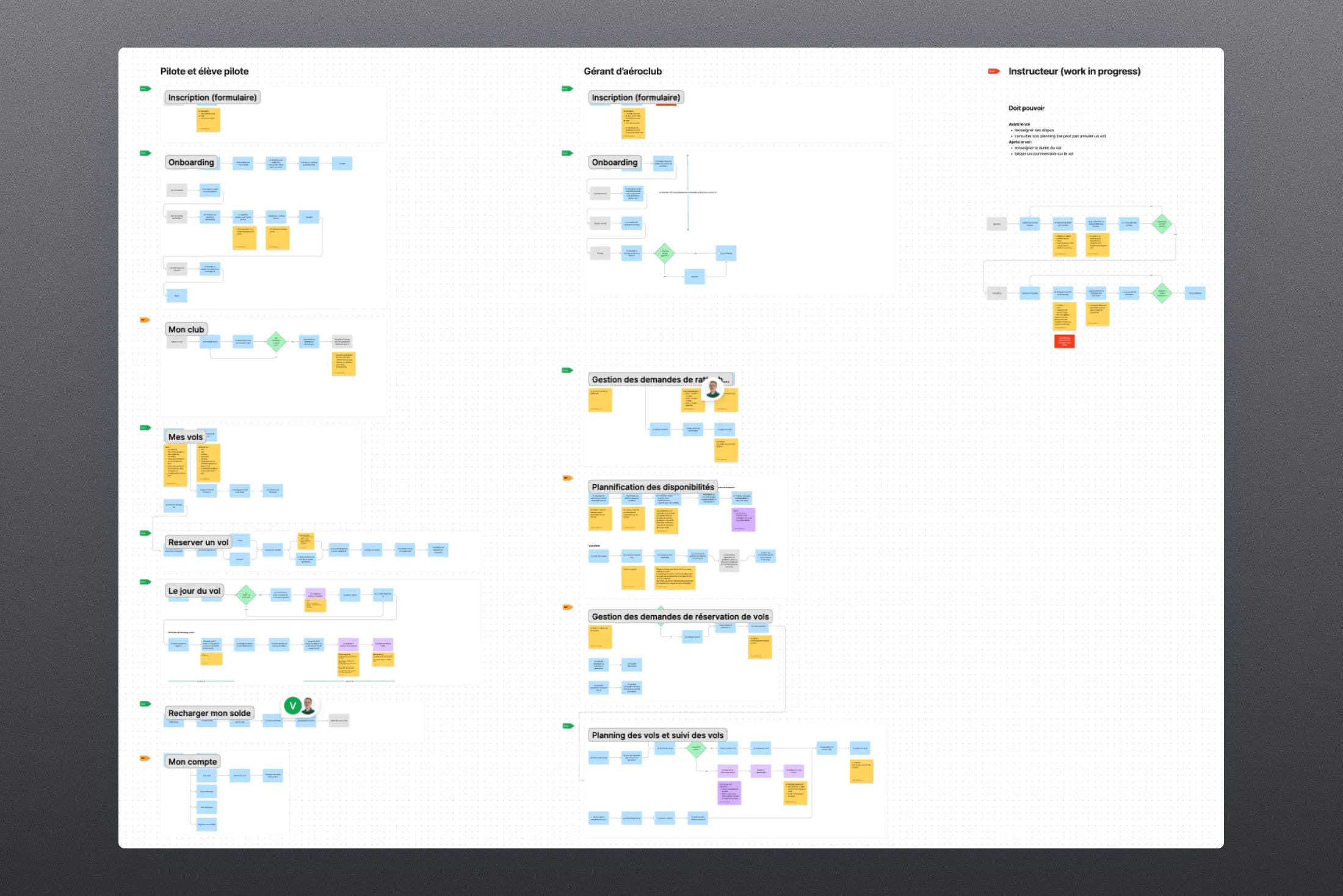
Before the flight: simplifying the process of joining a club, enabling multi-club membership with a single administrative file, and integrating Stripe for balance top-ups. During booking: streamlining the reservation process for pilots and optimizing the schedule view for managers. After the flight: simplifying flight time logging and automatically updating pilot balances. This end-to-end journey logic kept the functional scope coherent without spreading design and development effort too thin.
Mapping the full booking journey across the pilot, manager, and instructor was the starting point for identifying friction end-to-end. This preliminary work surfaced concrete pain points: phone calls to confirm availability, paper booking logs prone to errors, and a complete lack of real-time visibility into the schedule for managers.
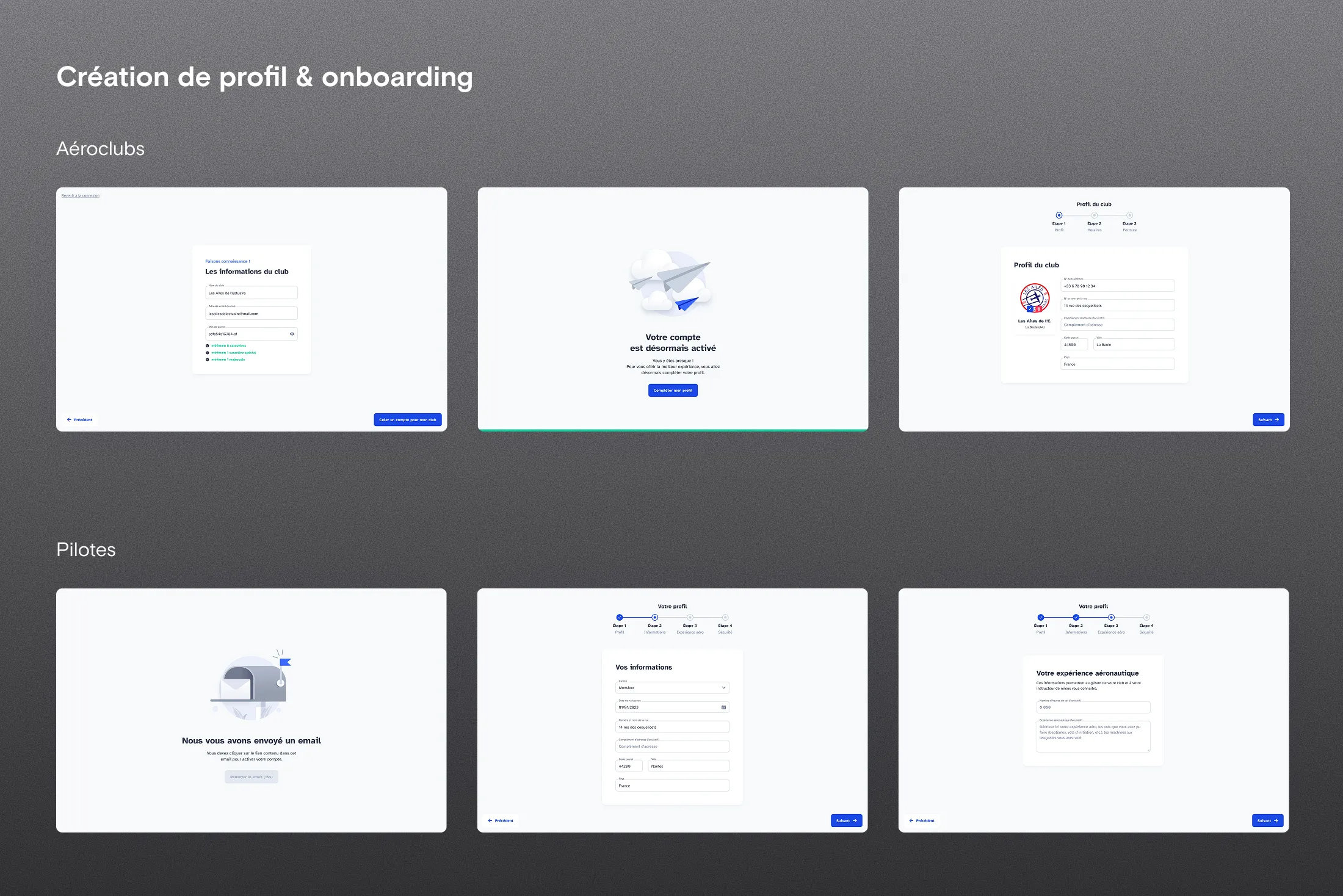
The wireframes translated these findings into streamlined, linear flows, with particular attention to reducing cognitive load for users who were not necessarily comfortable with complex digital interfaces.
I designed the brand identity around the reference to Jean Mermoz, a legendary aviator and instantly recognizable figure in the aviation world, to create a memorable anchor for a traditional audience.
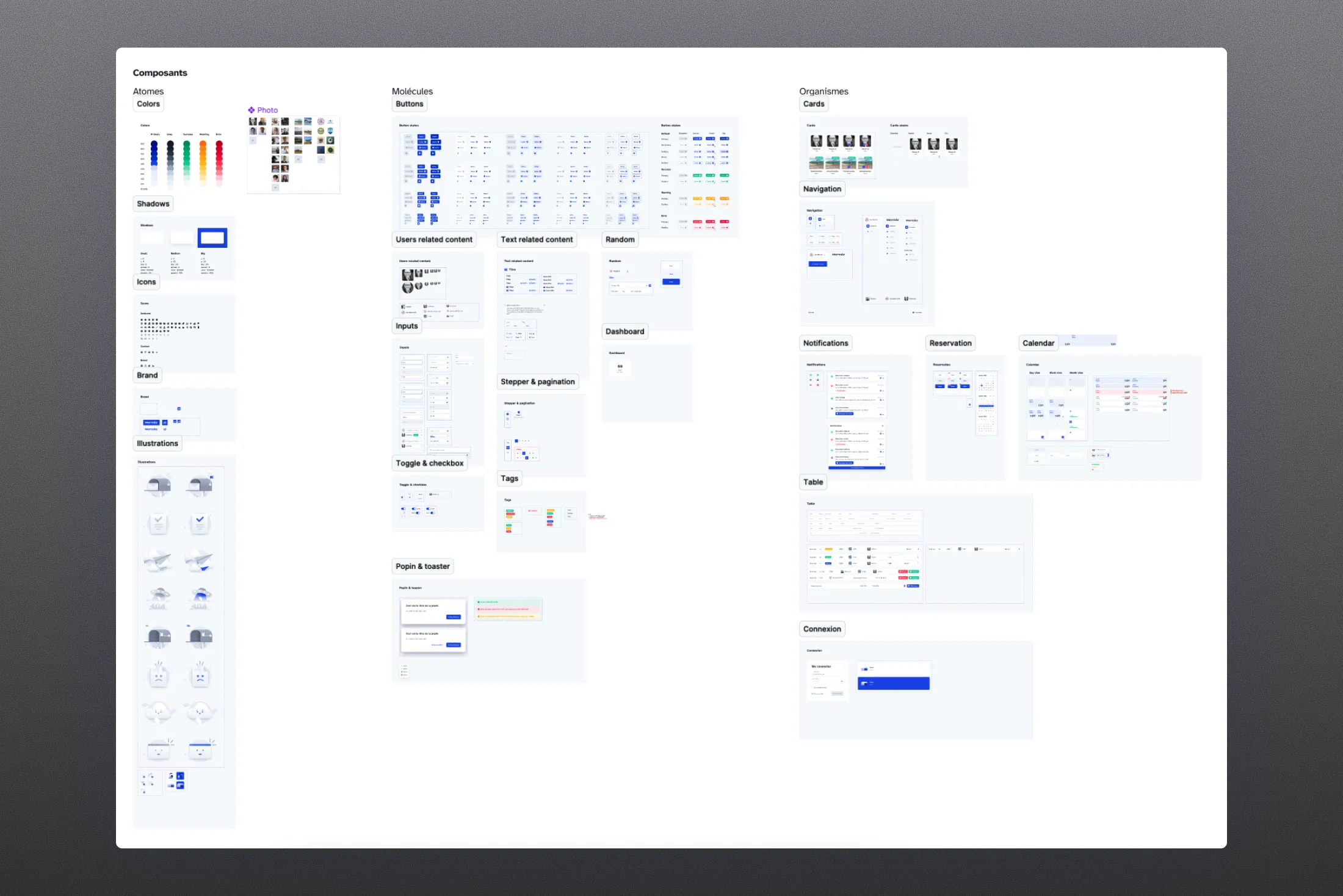
The interface was kept deliberately clean and efficient. After an initial design phase, I rationalized the component library to reduce its footprint, improve visual consistency, and lay the groundwork for an extensible UI kit. This phase was also an opportunity to experiment with Jitter for the logo animation, a detail that gave the product a visual personality beyond what one would typically expect from a management SaaS.
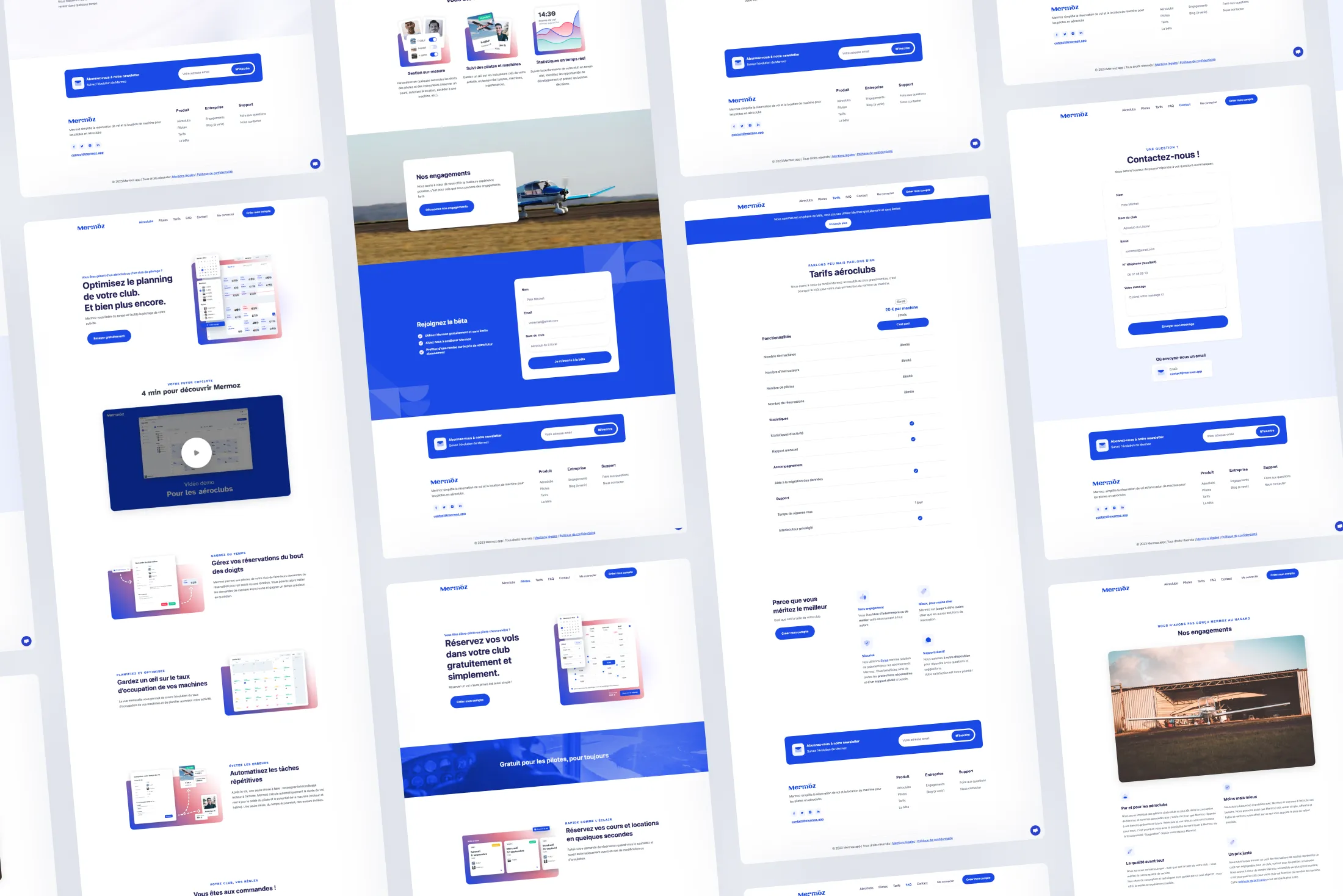
In parallel with the app design, I independently designed and built Mermoz's landing page on Webflow, with Pierre-Luc's help on content writing. The goal was twofold: presenting the promise and benefits to managers as the primary audience, while also addressing pilots as potential advocates within their clubs.
I produced all content, visuals, and a product demo video. The landing page also included a call to join the beta, with a discount as an incentive, to build an initial base of engaged users ahead of launch.
Once the project was presented to Lonestone, the MVP was built primarily by Ronan, Lonestone's co-founder, with valuable contributions from Mickael. We chose to build on Chakra UI to accelerate front-end integration, and Ronan made certain technical decisions that went slightly beyond a strict MVP scope to allow for smoother scaling if the product found its market.
Throughout this phase, I worked closely alongside the team, adapting mockups to technical constraints, making the necessary compromises, and keeping the goal in sight: shipping an MVP solid and compelling enough to convince the first clubs.
Outcomes
In the summer of 2023, I contacted nearly 200 flying clubs to present the solution and gather feedback. The signals were encouraging and led to re-prioritizing certain features to reach an experience level comparable to existing competitors.
Mermoz launched in beta at the end of 2023, with several clubs on board to iterate on the MVP. The project is currently on hold, due to insufficient resources in marketing and acquisition.
This project taught me what it truly means to carry a product from end to end, from identifying the problem through to development and launch. Two lessons feel particularly significant.
The first: I should have validated the idea far earlier, before designing anything, by building a bare-bones landing page, contacting clubs from the start, and finding partners willing to co-design the solution. A "fake it until you make it" approach would have saved time and substantially reduced the risk at launch.
The second: a simple idea can quickly become an unexpectedly complex project. The business rules, the specific requirements of each club, the communication, the marketing, the development oversight — it is a full-time job, and I underestimated it. As a first entrepreneurial venture, I should have started with something smaller and simpler.
