
Introduction
Les Mini Mondes is a Nantes-based company that helps children discover the world through educational magazines and eco-friendly toys, 100% made in France. With a community of over 80,000 families already on board, the brand wanted to explore a new dimension of its offer: a mobile app that would become parents' first instinct when looking for kids-friendly places and activities.
Over one week of design sprint, I designed the foundation of what would become the Les Mini Mondes app, drawing on the existing community to make real-time design decisions, from the initial brief through to a tested prototype.
How might we design and validate an app concept in one week, in order to give the Les Mini Mondes community a tool that becomes parents' go-to reflex for organising activities with their children?
UX/UI product design: journeys, wireframes, content and prototype.
Guerilla research through Instagram polls + user testing to validate decisions during the sprint.
Product scoping & prioritisation: clarifying the value proposition, locking scope and preparing the backlog.
Problem Definition
The family-friendly app market is dominated by generalist players (Google Maps, TripAdvisor) that are not built with families in mind and do not filter their content accordingly. Les Mini Mondes had a head start: an engaged community, a trusted brand and a clear promise around eco-responsibility and French craftsmanship.
The challenge was not to build a product from scratch, but to extend an existing relationship of trust into a new digital space, offering something the large platforms cannot: a selection curated by and for families.
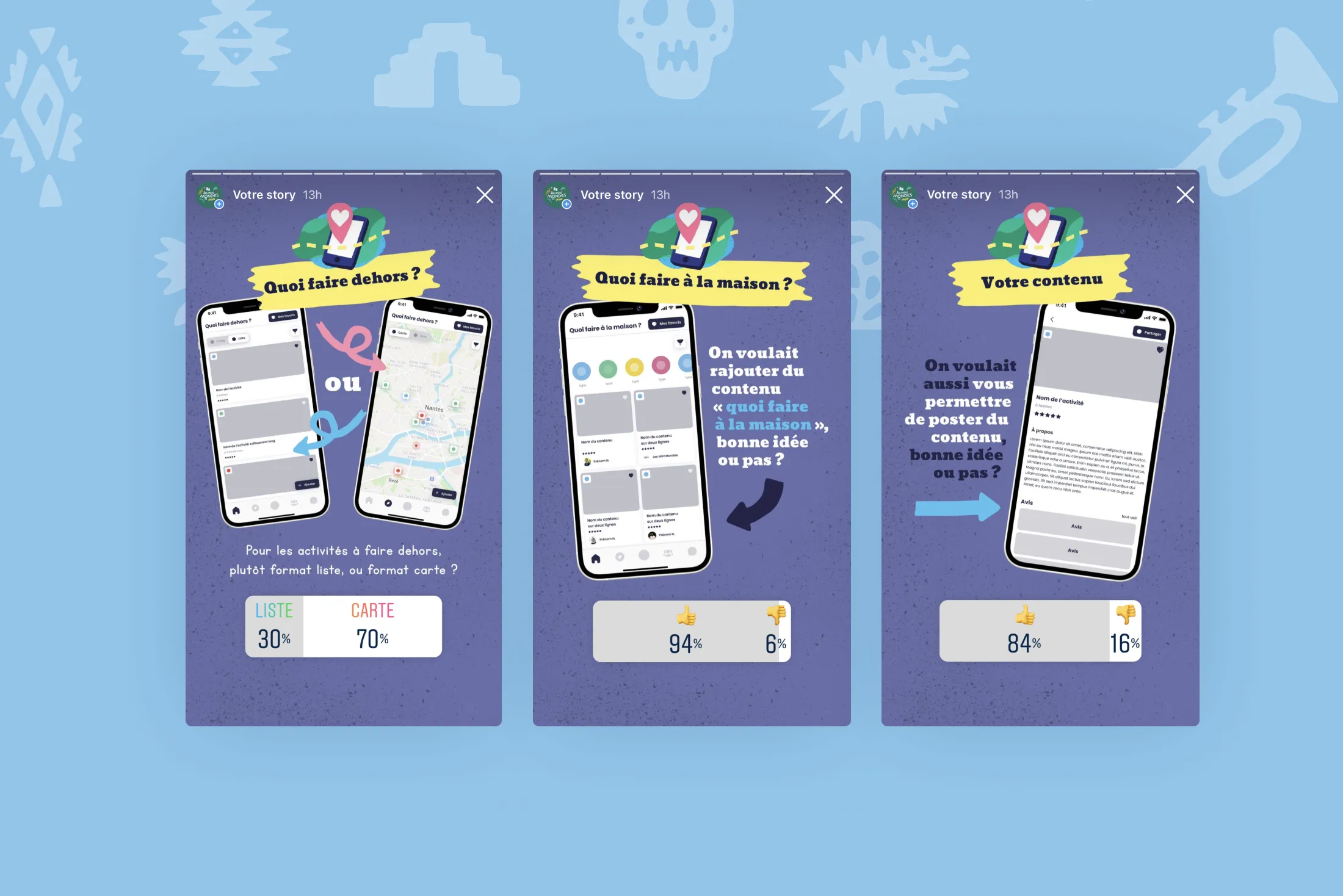
User research took two complementary forms, both run in guerilla mode to fit the sprint format. On one side, daily polls on the Les Mini Mondes Instagram account, with results collected every morning to inform the day's design decisions.
These polls helped settle structuring questions: should points of interest be displayed as a map or as a list? Should users be able to post their own content? Should the app include indoor activities, given that its primary purpose was to encourage families to go outside?
On the other side, six user testing sessions were run on day six of the sprint, with a mix of parents already familiar with Les Mini Mondes and parents who had never heard of the brand, to validate the prototype before the final debrief.
An existing community as a design accelerator
With 80,000 families already engaged, Les Mini Mondes had a natural and responsive test panel. Tapping into that community directly during the sprint meant making decisions based on real data rather than assumptions.
A trusted brand to extend into a new medium
Parents who already buy Les Mini Mondes magazines and toys trust the brand's curation. An app that extends that promise came with built-in credibility that most new products spend months trying to earn.
The right reflex, not the most exhaustive tool
The ambition was not to compete with Google Maps or TripAdvisor on content volume, but to offer a more focused, simpler and more reliable experience for families. Fewer results, better filtered, better suited.
Solution Design
The sprint followed a structure adapted to the project's constraints: one day of immersion, two days of exploration and scoping, two days of design (wireframes, content and a first UI layer), then two days dedicated to testing and analysis.
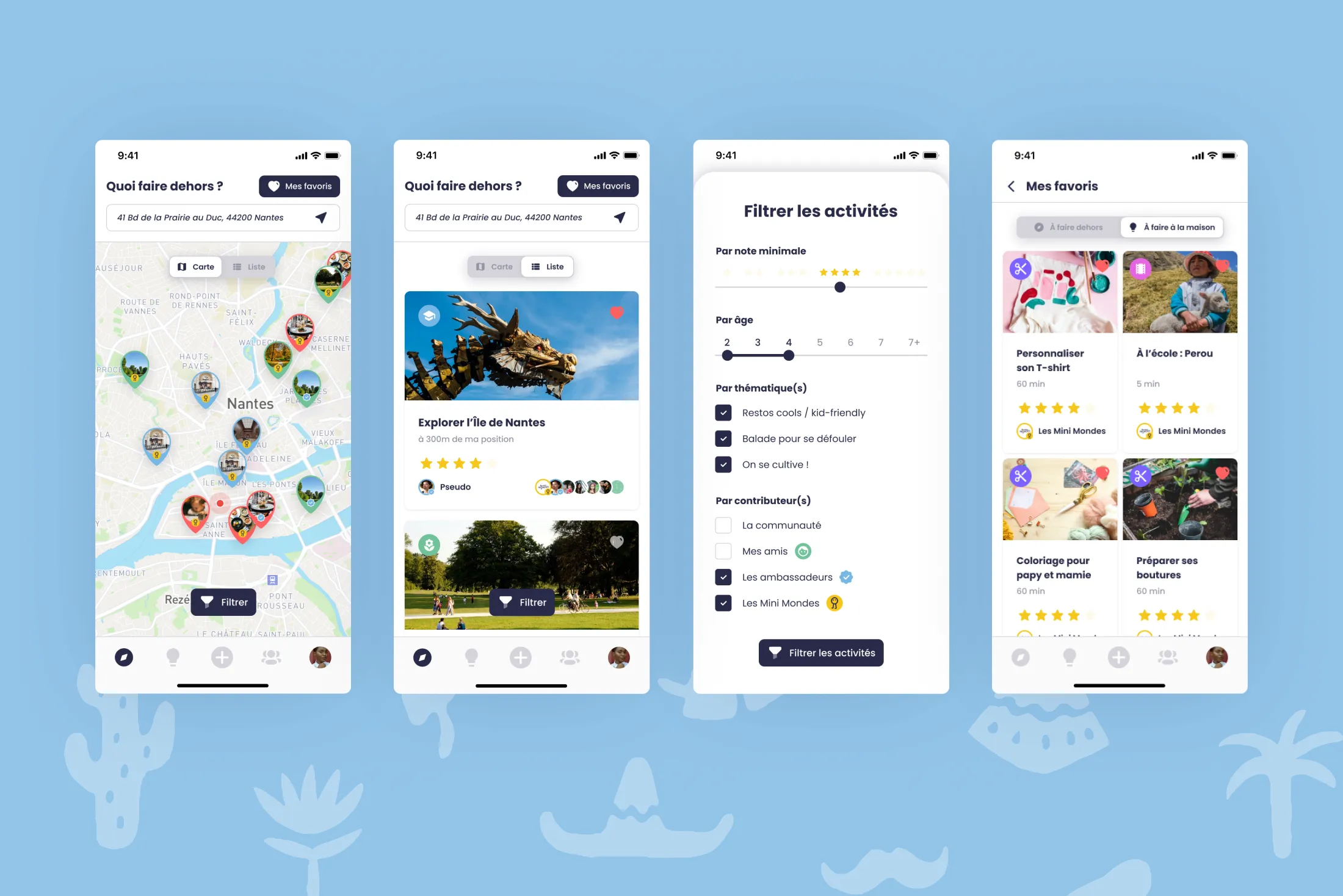
The scope was locked mid-week around the features most directly tied to the core value proposition: discovering kids-friendly places and activities, the sign-up and onboarding journey, and navigation between map and list views.
The most open-ended scope questions (user-generated content, indoor activities) were settled through the Instagram polls, avoiding lengthy internal debates.
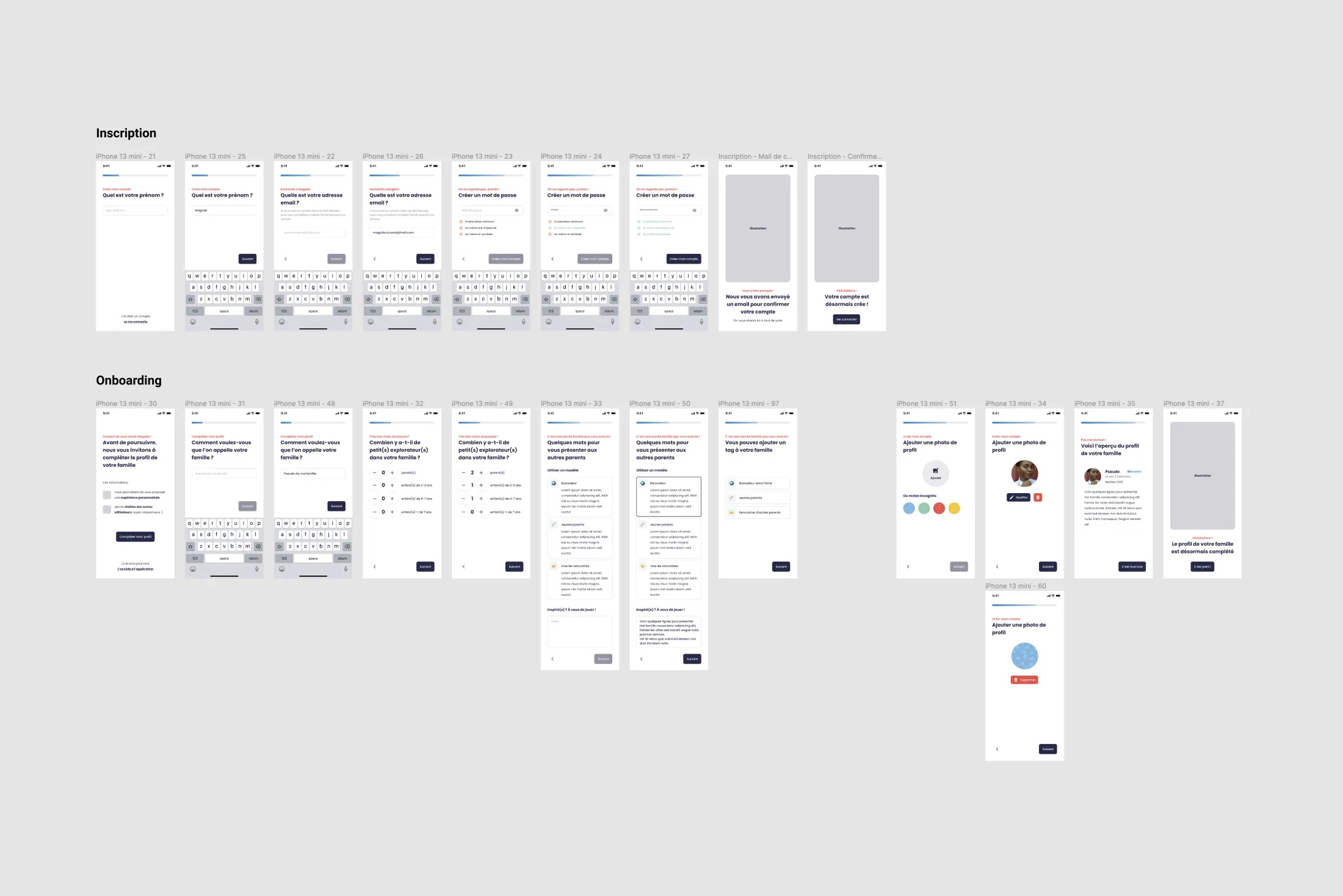
Every evening, I delivered a selection of screens to Marine and Quentin so they could react, challenge the choices and bring back feedback from their side. This daily iteration rhythm kept design intentions and the founders' vision in constant alignment, without ever losing touch with the ground.
Wireframes progressively integrated real content so that the day-six user tests would run in conditions close to those of the actual product. The prototype delivered at the end of the week covered the full journey, from the first time a user opens the app through to consulting an activity detail page.
The time constraint called for a pragmatic approach: a light UI layer, consistent with the Les Mini Mondes visual universe, polished enough for testers to picture themselves in the product without visual choices interfering with navigation feedback.
The goal was to validate the journeys, not to finalise a visual identity. The next phase of the project, handed to Adeline for final design, was able to build on these foundations and go further on the visual side.
At the end of the sprint, Nadia, the Product Owner, joined the debrief to review the week and define recommendations for the next phase. Together we established the product backlog and prioritised features in preparation for what came next.
Final app design was then taken over by Adeline, and development was handled by the Lonestone engineering team in partnership with Les Mini Mondes' internal tech team.
Results & Learnings
The app was not launched, as other priorities took precedence in Les Mini Mondes' roadmap. Even so, the mission fully achieved its objective: producing in one week a validated concept, a tested prototype and a prioritised backlog, ready to hand over for the next phase.
Community engagement during the Instagram polls was particularly strong, confirming both the appetite of families for this kind of service and the solidity of the relationship between the brand and its community.
This sprint confirmed something I had sensed but never measured so directly: having an existing community, even a small one, fundamentally changes the nature of product risk. Being able to ask your community a question in the evening and have answers by the following morning is a form of continuous, low-cost user research that most early-stage startups simply do not have access to.
It saves time, reduces uncertainty and makes it possible to settle design debates with data rather than opinions.
What would I do differently? I would have liked to include more non-users of the brand in the Instagram polls, not only in the final tests. The Les Mini Mondes community is engaged and generous, which is a real strength, but it can also skew responses in the brand's favour. Exposing design hypotheses to more neutral perspectives from the start would have strengthened the robustness of the decisions made during the sprint.
