
Introduction
Mom3nt is an AI-first SaaS platform designed for sales teams: it combines CRM data, email exchanges, and external signals to automatically recommend the right nurturing action at the right moment. Arnaud Gagne and Alexandre Lam, two entrepreneurs with over twenty years of sales experience each, held a strong conviction about AI's potential to transform sales practices. They came to Lonestone to bring that vision to life and ship a functional MVP. I led the UX and UI design of the product in collaboration with Valentin, Lonestone's product manager, focusing on the scoping and design phase that preceded development.
How might we turn an ambitious AI-driven product vision into a concrete and usable MVP, in order to validate adoption by sales teams and lay the foundations for rapid iteration?
Wireframes, high-fidelity mockups, design system
Userflows, feature prioritization, MVP architecture
Xontinuous alignment with the technical team
Problem Definition
The benchmark of existing solutions, Salesforce, HubSpot, Outreach, and their equivalents, served less as a source of inspiration than as a way to understand their limitations and clarify Mom3nt's positioning. These tools have become standard in sales teams, but their widespread adoption also creates a dependency: salespeople don't want to replace them, they want help extracting more value from them. This observation drove a structuring product decision from the very start of the scoping phase: Mom3nt would not compete with HubSpot or Salesforce, but connect to them and enrich them, positioning itself as an intelligent layer on top of the tools already in place.
As experienced salespeople themselves, the two founders played a central role in defining user needs, carrying both the product vision and the voice of the field. In addition, they shared pre-mockups with their professional network to gather feedback and refine the value proposition before design began. This approach allowed the work to be grounded in real-world usage patterns, while keeping an iterative frame around which features to prioritize.
Fit into the existing workflow rather than replacing it
Salespeople don't have time to learn a new tool. By designing Mom3nt as a layer on top of their current tools, connected to their CRM and their inbox, the product could deliver value without adoption friction and without disrupting established habits.
Make AI tangible from the very first minutes of use
In an AI-first product, the risk is that users don't concretely perceive what AI is doing for them. The design challenge was to make recommendations immediately readable, actionable, and grounded in each salesperson's real context, without exposing the complexity of the underlying agents.
Do less but do it better to validate the product hypothesis
With a constrained budget and timeline, trying to cover everything in the MVP would have been fatal. Rigorously prioritizing high-value use cases, commercial analysis, prospecting support, and message recommendations, made it possible to ship a product testable in real conditions without sacrificing the quality of the experience.
Solution Design
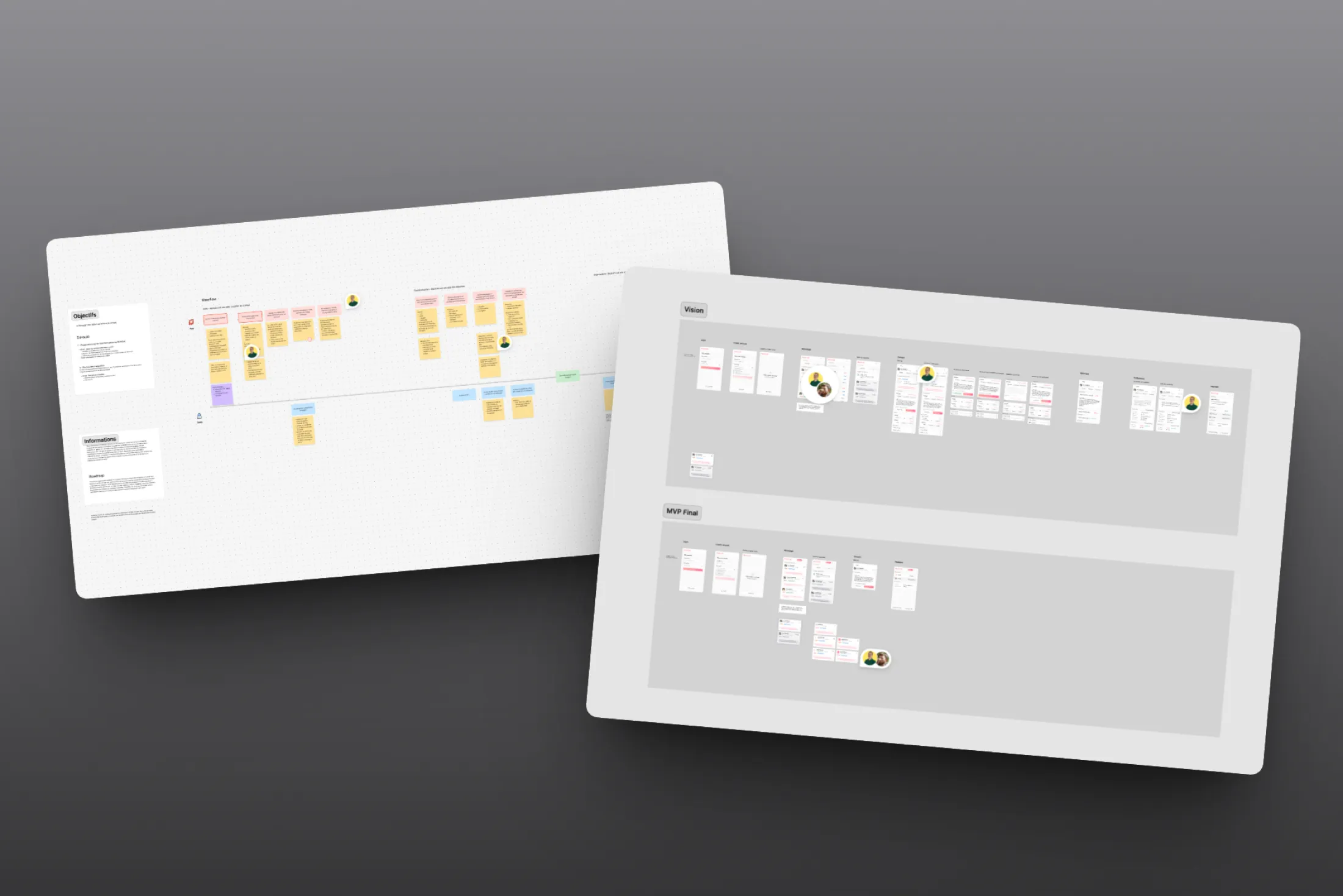
The shape phase involved translating the founders' vision into a clear and realistic functional scope. Together with Valentin, we structured the backlog by distinguishing what was essential to validate the product hypothesis from what could be deferred without compromising the MVP's value. The features retained in priority covered onboarding, CRM connection, follow-up summaries, AI-generated message suggestions, and recommended actions. User flows were mapped to minimize cognitive load at each step, particularly at the moments where AI intervenes, where it was critical that users immediately understood what was being proposed and why.
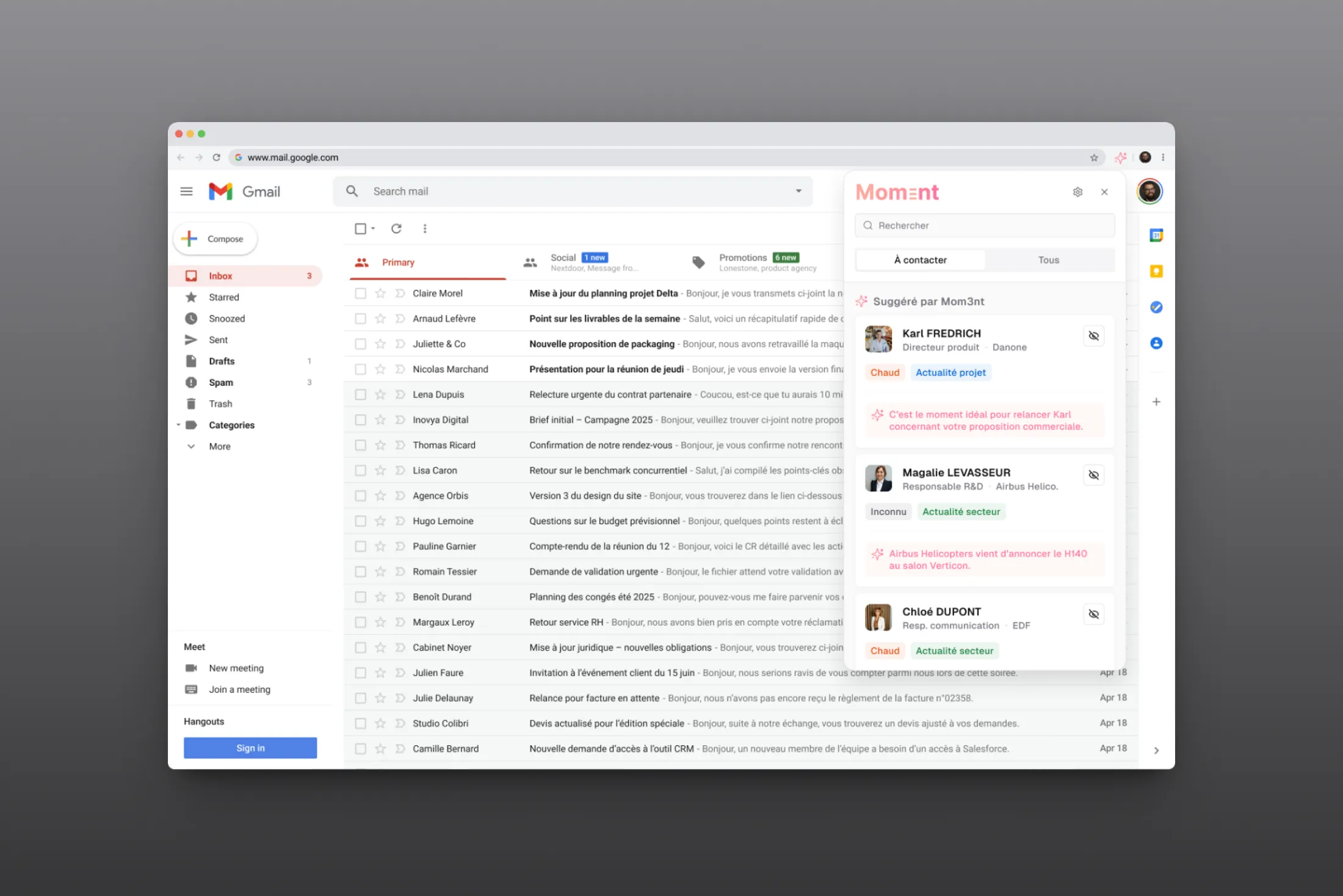
The design was structured around the key moments in a salesperson's day: reviewing contacts to follow up with, understanding the context of a relationship, and acting quickly on a recommendation. Wireframes were produced to validate flows before moving to high-fidelity mockups, with regular back-and-forth with the founders to ensure that interface decisions accurately reflected real-world usage patterns. The browser extension was also integrated from the scoping phase as a deliberate product positioning choice: rather than asking salespeople to switch context, Mom3nt projects itself directly into Gmail, where they already work.
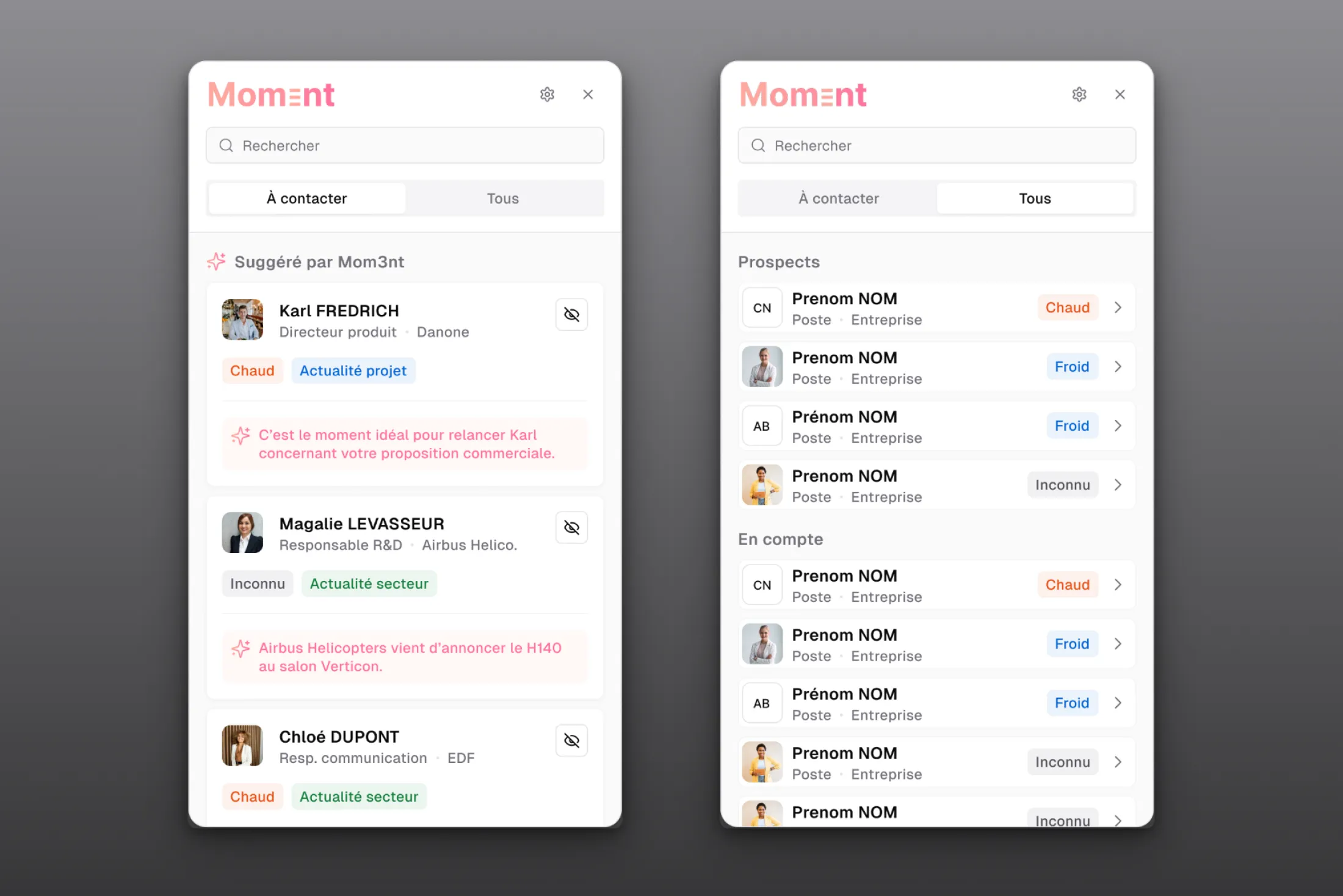
The interface was designed from scratch using the shadcn/ui component library as a foundation, which I fully adapted and extended to meet the product's specific needs. This choice saved time on the foundations while preserving full creative freedom over the visual direction. The main UI challenge was finding the right balance between information density, a product aimed at salespeople who process large volumes of data, and readability, so that AI recommendations could be understood immediately without requiring interpretation effort.
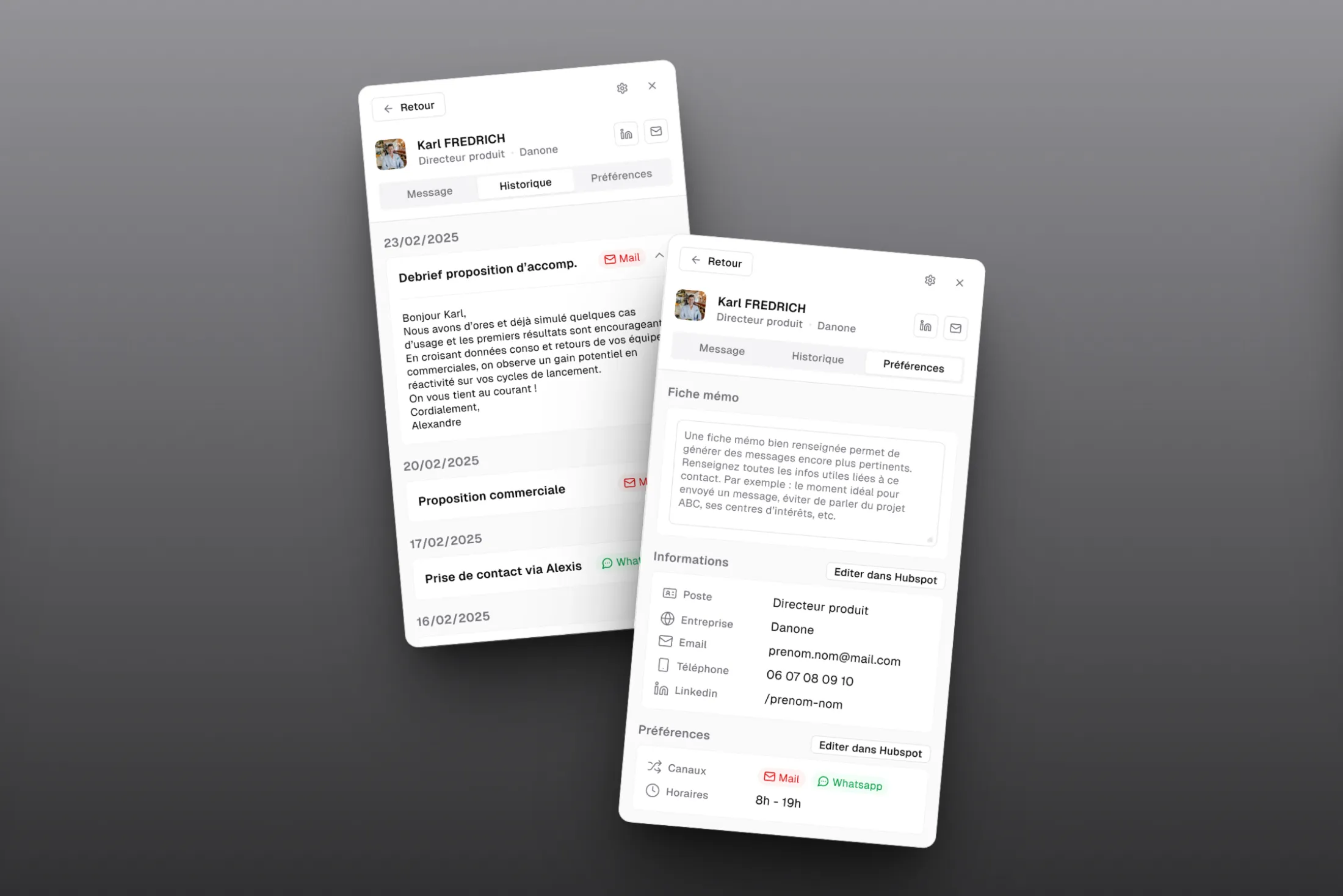
Throughout the build phase, I maintained continuous UX oversight alongside the development team to ensure that implementation faithfully reflected the intended flows. Adjustments were made iteratively based on internal reviews and early feedback from pilot users, in a short-cycle iteration approach consistent with the project’s budget and timeline.
Results & Learnings
The MVP was delivered in five months, with operational CRM and messaging integrations, a functional multi-agent AI layer, and a browser extension embedded directly in Gmail. The product was adopted by early B2B pilot customers without requiring extensive onboarding, validating the central hypothesis of the scoping phase: a well-designed product, anchored in existing tools, can be adopted quickly even by sales teams who are typically resistant to changing their habits. Mom3nt is now continuing its commercial rollout and expanding its agent logic.
This project reinforced something I now consider fundamental: with a constrained budget and timeline, prioritization discipline is the most valuable skill a designer can bring. Doing less but doing it better is not a compromise, it is a strategy. An MVP that validates a strong hypothesis on a focused scope is infinitely more useful than an over-ambitious product that never reaches real conditions. What would I do differently? I would have pushed to get salespeople in front of the mockups earlier in the process, rather than relying solely on the founders as intermediaries. Their field experience was invaluable, and their network provided useful feedback, but nothing replaces watching a real user interact with a prototype to surface the friction that even the best brief cannot anticipate.
